


Page 40 - WEF Reoprt 2020
P. 40
agriculture system to practices such as    organizations.  Overall, lack of consistent
                                                                   62
            regenerative farming would require radical   awareness-raising among business leaders
            shifts in subsidies and investment. Similarly,   may create first-mover advantages for some,
            about 10% of global emissions comes        but it also potentially demonstrates the
            from the very high heat levels required to   much more concerning overarching risk: that
            produce commodities—such as cement,        many businesses may not be planning for
            steel and petrochemicals—and, although     the physical and financial risks that climate
            low-carbon alternatives do exist, they are   change may have on their activities and
            currently costly.  New public-private initiatives   across their value chains.
                         55
            such as the Mission Possible Platform,
            launched at the UN Climate Action Summit in
            September 2019, are designed to help heavy
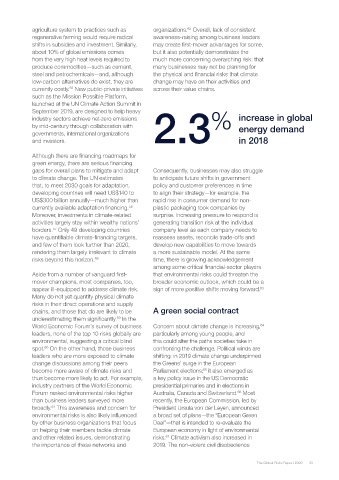
            industry sectors achieve net-zero emissions                    %         increase in global
            by mid-century through collaboration with   2.3                          energy demand
            governments, international organizations
            and investors.                                                           in 2018

            Although there are financing roadmaps for
            green energy, there are serious financing
            gaps for overall plans to mitigate and adapt   Consequently, businesses may also struggle
            to climate change. The UN estimates        to anticipate future shifts in government
            that, to meet 2030 goals for adaptation,   policy and customer preferences in time
            developing countries will need US$140 to   to align their strategy—for example, the
            US$300 billion annually—much higher than   rapid rise in consumer demand for non-
            currently available adaptation financing.    plastic packaging took companies by
                                              56
            Moreover, investments in climate-related   surprise. Increasing pressure to respond is
            activities largely stay within wealthy nations’   generating transition risk at the individual
            borders.  Only 49 developing countries     company level as each company needs to
                    57
            have quantifiable climate-financing targets,   reassess assets, reconcile trade-offs and
            and few of them look further than 2020,    develop new capabilities to move towards
            rendering them largely irrelevant to climate   a more sustainable model. At the same
            risks beyond this horizon. 58              time, there is growing acknowledgement
                                                       among some critical financial-sector players
            Aside from a number of vanguard first-     that environmental risks could threaten the
            mover champions, most companies, too,      broader economic outlook, which could be a
            appear ill-equipped to address climate risk.   sign of more positive shifts moving forward. 63
            Many do not yet quantify physical climate
            risks in their direct operations and supply
            chains, and those that do are likely to be   A green social contract
            underestimating them significantly.  In the
                                          59
            World Economic Forum’s survey of business   Concern about climate change is increasing,
                                                                                            64
            leaders, none of the top 10 risks globally are   particularly among young people, and
            environmental, suggesting a critical blind   this could alter the paths societies take in
            spot.  On the other hand, those business   confronting the challenge. Political winds are
                 60
            leaders who are more exposed to climate    shifting: in 2019 climate change underpinned
            change discussions among their peers       the Greens’ surge in the European
            become more aware of climate risks and     Parliament elections;  it also emerged as
                                                                        65
            thus become more likely to act. For example,   a key policy issue in the US Democratic
            industry partners of the World Economic    presidential primaries and in elections in
            Forum ranked environmental risks higher    Australia, Canada and Switzerland.  Most
                                                                                    66
            than business leaders surveyed more        recently, the European Commission, led by
            broadly.  This awareness and concern for   President Ursula von der Leyen, announced
                   61
            environmental risks is also likely influenced   a broad set of plans—the “European Green
            by other business organizations that focus   Deal”—that is intended to re-evaluate the
            on helping their members tackle climate    European economy in light of environmental
            and other related issues, demonstrating    risks.  Climate activism also increased in
                                                           67
            the importance of these networks and       2019. The non-violent civil disobedience


                                                                                           The Global Risks Report 2020  35

