


Page 39 - WEF Reoprt 2020
P. 39
And lastly, and perhaps most vital, is the   helpful mechanisms to bolster political
                           risk that the specific multilateral process   confidence that climate change can be
                           mandated to address climate change loses   successfully tackled.
                           momentum and action on climate stalls.
                           For example, the recent failure at COP25
                           to develop a rule book for a new global    Can societies deliver?
                           carbon market means there is not yet a
                           credible system that would allow countries   Climate and corresponding economic risks
                           to pay each other for projects that reduce   threaten a 2008-style systemic collapse,
                                                                                                        48
                           emissions. The risk here is not simply that   unless net human-caused carbon dioxide
                           we lose an unaffordable five years, but    (CO2) emissions fall by 50% by 2030
                           that the perception of failure drains more   relative to 2010, and to net zero by 2050.
                           political support from the multilateral process   Reaching these targets will require serious,
                           and undermines the prospects for future    interconnected economic and societal
                           progress. However, encouraging steps       transitions at macro and micro levels
                           are already being taken by various new     that depend on technological innovation
                           geometries of governments, companies,      and commitment from governments and
                           investors, sub-national entities and civil   businesses. So far, however, commitments are
                           society working together on key areas of   inadequate given the urgency of the challenge
                           climate action, such as the energy and     and current trends are not encouraging.
                           industry transition, the mobilization of finance
                           and agriculture, and nature-based solutions.   Most critically, demand for energy is
                           These multistakeholder efforts to advance   continuing to increase and much of this
                           climate action, as highlighted at the 2019 UN   demand is still being met by fossil fuels.
                           Climate Action Summit, are becoming an     Global energy demand rose by 2.3% in
                           increasingly important component of        2018, the fastest pace in a decade.  China,
                                                                                                    49
                           the international response. They are also   the United States and India account for
                                                                      nearly 70% of the rise. Energy demand is
                                                                      expected to grow even further—by over
                                                                      25% by 2040—driven by population growth,
                                                                      increasing incomes and urbanization: in
                                                                      developing economies, 1.7 billion people are
                                                                      expected to move to urban areas in the next
                                                                      two decades. 50


                                                                      There is a clear tension between calls to green
                                                                      society and the drive, particularly in emerging
                                                                      markets, to boost economic growth through
                                                                      investment in carbon-heavy projects such
                                                                      as roads, dams, energy resources, mines
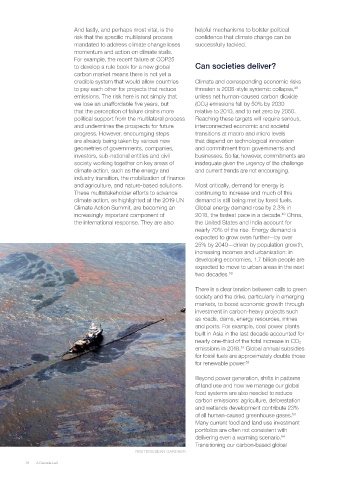
                                                                      and ports. For example, coal power plants
                                                                      built in Asia in the last decade accounted for
                                                                      nearly one-third of the total increase in CO2
                                                                      emissions in 2018.  Global annual subsidies
                                                                                      51
                                                                      for fossil fuels are approximately double those
                                                                      for renewable power. 52

                                                                      Beyond power generation, shifts in patterns
                                                                      of land use and how we manage our global
                                                                      food systems are also needed to reduce
                                                                      carbon emissions: agriculture, deforestation
                                                                      and wetlands development contribute 23%
                                                                      of all human-caused greenhouse gases.
                                                                                                        53
                                                                      Many current food and land use investment
                                                                      portfolios are often not consistent with
                                                                      delivering even a warming scenario.
                                                                                                    54
                                                                      Transitioning our carbon-based global
                                                 REUTERS/SEAN GARDNER

          34  A Decade Left

