


Page 57 - WEF Reoprt 2020
P. 57
Bio-economic transitions would create      circular economy, in which waste is designed
                           feedback loops that must also be           out and materials are kept in use for as long
                           considered. For example, developing        as possible: besides helping to decouple
                           climate-resistant crop varieties could     resource demand from economic growth,
                           help farming systems adapt to a warming    this can contribute to lower emissions and
                           planet—but deepening our reliance on a     less habitat loss.
                           handful of staple crops grown in large-
                           scale, intensive monoculture farming       There is also a business rationale for
                           systems could ultimately undermine the     preserving or restoring natural ecosystems.
                                                                                                           74
                           resilience of the food system by reducing   On average, the costs of restoration are
                           genetic diversity and increasing vulnerability   outweighed tenfold by its benefits to
                           to pests and disease.  On a smaller scale,   communities.  Restoring coastal mangroves,
                                                                                 75
                                              67
                           urban tree-planting might actually result in   for example, can protect land from storm
                           a net loss of street-tree carbon storage over   surges and coastal erosion, develop fisheries
                           time because of the “unique demographics   and support ecotourism. Investing in the
                           of urban ecosystems”. 68                   restoration of wetlands, mangroves and
                                                                      coral reefs could reduce insurance costs
                           Inequities in development trajectories that   for businesses in coastal areas vulnerable
                           characterize the climate debate are also   to flooding. Likewise, financing ecological
                           inherent in any coordinated response to    forestry practices could reduce insurance
                                          biodiversity loss. Certain   costs for businesses, such as power and
                                          countries, for example,
                                                                      water utilities, that are exposed to wildfire
          70              %               may incur a stiffer penalty   risks.  According to the Organisation for
                                                                          76
                                                                      Economic Co-operation and Development
                                          for the protection of the
                                          planet by virtue of their
                                                                      (OECD), restoring 46% of the world’s
                                          geography and natural
                                                                      degraded forests could provide up to US$30
                                                                      local employment and increasing community
                                          conservation efforts do
          agricultural land               resources. However,         in benefits for every dollar spent, boosting
                                                                      awareness of biodiversity’s importance.
                                          not necessarily require
                                                                                                        77
          use accounted                   trade-offs in development  69
          for by livestock                priorities or human rights.    A critical challenge for the biodiversity
                                                                      agenda will be finding investment models
                                          In fact, efforts to address
          sector                          declining biodiversity ought   that mobilize private finance to capture a
                                          to be inextricably linked   share of this opportunity. New approaches
                                          to other social agendas,    are emerging, such as resilience-financing
                                          such as poverty alleviation,   structures through which businesses can
                           healthcare, disaster relief and protection   invest in the restoration of ecosystems in
                           of human rights.  It is vital to expand    return for a reduction in insurance premiums
                                         70
                           discussion around biodiversity loss to include   or risk-financing costs. Better data to track
                           researchers from non-empirical disciplines   the effectiveness of investments will be
                           as well as farmers, indigenous communities,   critical. However, given the sums involved—
                           businesses and other stakeholders.         one estimate puts the current cost of
                                                                      protecting biodiversity at US$100 billion per
                                                                      year —public funding will also be needed.
                                                                         78
                           The new nature economy                     Habitat protection and restoration are highly
                                                                      beneficial public goods for which government
                           While trade-offs may be unavoidable, there   investment is more than justified. The People’s
                           are also potential “win-wins”. Consider diets.   Bank of China, for instance, now offers capital
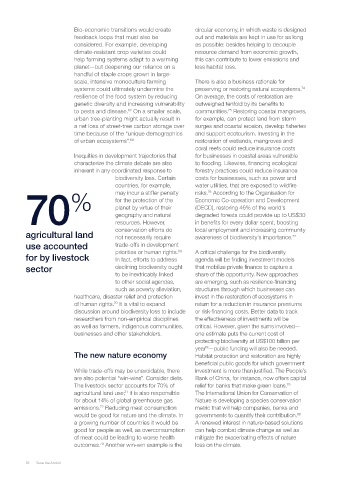
                           The livestock sector accounts for 70% of   relief for banks that make green loans.
                                                                                                      79
                           agricultural land use;  it is also responsible   The International Union for Conservation of
                                             71
                           for about 14% of global greenhouse gas     Nature is developing a species conservation
                           emissions.  Reducing meat consumption      metric that will help companies, banks and
                                    72
                           would be good for nature and the climate. In   governments to quantify their contribution.
                                                                                                         80
                           a growing number of countries it would be   A renewed interest in nature-based solutions
                           good for people as well, as overconsumption   can help combat climate change as well as
                           of meat could be leading to worse health   mitigate the exacerbating effects of nature
                           outcomes.  Another win-win example is the   loss on the climate.
                                    73

          52  Save the Axolotl

