


Page 52 - WEF Reoprt 2020
P. 52
Biodiversity is declining faster than it has

               at any other time in human history


            non-indigenous species that edge out       Food insecurity
            native ones; this has increased by 40%     Biodiversity underpins the world’s food
            globally over the same period. Fifth, climate   system.  It creates and maintains healthy
                                                             17
            change exacerbates nature loss, which in   soils, pollinates plants, purifies water and
            turn reduces nature’s resilience to climate   protects against extreme weather events,
            change—a vicious circle. 9                 among other vital services.  The ongoing
                                                                              18
                                                       loss of diversity in indigenous domesticated
            Less directly, losses of biodiversity are    plants and animals is undermining the
            driven by population growth, trade,        resilience of agricultural systems against
            consumption patterns and urbanization.     pests, pathogens and climate change.
                                              10
                                                                                        19
            By 2030, cities are expected to cover three   Declining diversity of fish species is
            times as much land as they did in 2000, with   correlated with lower catches and
            many of the expansions occurring in key    higher incidence of stock
            biodiversity hotspots.  Inadequate export   collapse.  A new report
                              11
                                                               20
            controls have facilitated the spread of invasive   from the United Nations’
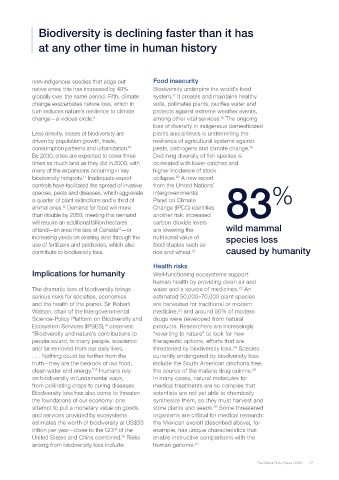
            species, pests and diseases, which aggravate   Intergovernmental                    %
            a quarter of plant extinctions and a third of   Panel on Climate    83
            animal ones.  Demand for food will more    Change (IPCC) identifies
                       12
            than double by 2050; meeting this demand   another risk: increased
            will require an additional billion hectares   carbon-dioxide levels
            of land—an area the size of Canada —or     are lowering the         wild mammal
                                          13
            increasing yields on existing land through the   nutritional value of    species loss
            use of fertilizers and pesticides, which also   food staples such as
            contribute to biodiversity loss.           rice and wheat. 21       caused by humanity


                                                       Health risks
            Implications for humanity                  Well-functioning ecosystems support
                                                       human health by providing clean air and
            The dramatic loss of biodiversity brings   water and a source of medicines.  An
                                                                                     22
            serious risks for societies, economies     estimated 50,000–70,000 plant species
            and the health of the planet. Sir Robert   are harvested for traditional or modern
            Watson, chair of the Intergovernmental     medicine,  and around 50% of modern
                                                                23
            Science-Policy Platform on Biodiversity and   drugs were developed from natural
            Ecosystem Services (IPBES),  observes:     products. Researchers are increasingly
                                      14
            “Biodiversity and nature’s contributions to   “reverting to nature” to look for new
            people sound, to many people, academic     therapeutic options, efforts that are
            and far removed from our daily lives.      threatened by biodiversity loss.  Species
                                                                                   24
            . . . Nothing could be further from the    currently endangered by biodiversity loss
            truth—they are the bedrock of our food,    include the South American cinchona tree,
            clean water and energy.”  Humans rely      the source of the malaria drug quinine.
                                  15
                                                                                          25
            on biodiversity in fundamental ways,       In many cases, natural molecules for
            from pollinating crops to curing diseases.   medical treatments are so complex that
            Biodiversity loss has also come to threaten   scientists are not yet able to chemically
            the foundations of our economy: one        synthesize them, so they must harvest and
            attempt to put a monetary value on goods   store plants and seeds.  Some threatened
                                                                            26
            and services provided by ecosystems        organisms are critical for medical research:
            estimates the worth of biodiversity at US$33   the Mexican axolotl (described above), for
            trillion per year—close to the GDP of the   example, has unique characteristics that
            United States and China combined.  Risks   enable instructive comparisons with the
                                            16
            arising from biodiversity loss include:    human genome.
                                                                      27

                                                                                           The Global Risks Report 2020  47

