


Page 81 - WEF Reoprt 2020
P. 81
Global health security risks.              Serious as these risks are, it can be argued
                           Considerable progress has been made        that health systems nonetheless have a
                           since the Ebola epidemic in West Africa in   blueprint to mitigate them, and success
                           2014–2016, but health systems worldwide    requires only adequate attention. The same
                           are still under-prepared for significant   cannot be said for new health risks.
                           outbreaks of other emerging infectious
                           diseases, such as SARS, Zika and MERS.     Emerging Risks
                           A recent first-of-its-kind comprehensive   Longevity, lifestyle and climate changes
                           assessment of health security and          are transforming disease burdens. Health
                           related capabilities across 195 countries   systems need new infrastructure, resources
                           found fundamental weaknesses around        and skills, but in many parts of the world
                           the world: no country is fully prepared    they are failing to adapt—even as healthcare
                           to handle an epidemic or pandemic.         spending soars to unsustainable levels.
                                                           19
                           Meanwhile, our collective vulnerability
                           to the societal and economic impacts of    Non-communicable diseases (NCDs).
                           infectious disease crises appears to       As populations grow, age and urbanize,
                           be increasing. 20                          NCDs and mental disorders have replaced
                                                                      infectious diseases as the leading threats to
                                                                      health and health systems worldwide. Once
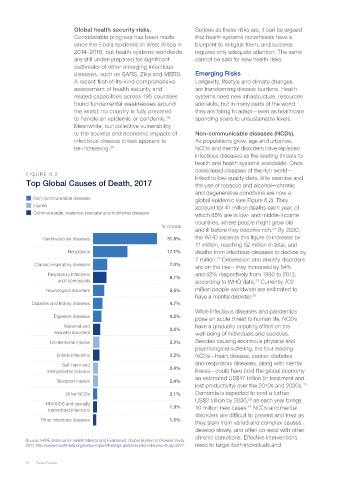
                                                                      considered diseases of the rich world—
          FIG URE 6 . 2                                               linked to low-quality diets, little exercise and
          Top Global Causes of Death, 2017                            the use of tobacco and alcohol—chronic

                                                                      and degenerative conditions are now a
             Non-communicable diseases                                global epidemic (see Figure 6.2). They
             Injuries                                                 account for 41 million deaths each year, of
             Communicable, maternal, neonatal and nutritional diseases  which 85% are in low- and middle-income
                                                                      countries, where people might grow old
                                                          % of total
                                                                      and ill before they become rich.  By 2030,
                                                                                                 21
                Cardiovascular diseases                     31.8%     the WHO expects this figure to increase by
                                                                      11 million, reaching 52 million in total, and
                         Neoplasms                          17.1%     deaths from infectious diseases to decline by
                                                                      7 million.  Depression and anxiety disorders
                                                                             22
             Chronic respiratory diseases                    7.0%     are on the rise—they increased by 54%
                  Respiratory infections                              and 42% respectively from 1990 to 2013,
                     and tuberculosis                        6.7%     according to WHO data.  Currently 700
                                                                                           23
                 Neurological disorders                      5.5%     million people worldwide are estimated to
                                                                      have a mental disorder. 24
            Diabetes and kidney diseases                     4.7%
                                                                      While infectious diseases and pandemics
                    Digestive diseases                       4.2%
                                                                      pose an acute threat to human life, NCDs
                        Maternal and                                  have a gradually crippling effect on the
                    neonatal disorders                       3.5%     well-being of individuals and societies.
                   Unintentional injuries                    3.2%     Besides causing enormous physical and
                                                                      psychological suffering, the four leading
                     Enteric infections                      3.2%     NCDs—heart disease, cancer, diabetes
                       Self-harm and                                  and respiratory diseases, along with mental
                  interpersonal violence                     2.4%     illness—could have cost the global economy
                                                                      an estimated US$47 trillion (in treatment and
                     Transport injuries                      2.4%
                                                                      lost productivity) over the 2010s and 2020s.
                                                                                                           25
                        Other NCDs                           2.1%     Dementia is expected to cost a further
                                                                      US$2 trillion by 2030,  as each year brings
                                                                                        26
                 HIV/AIDS and sexually                                                  27
                  transmitted infections                     1.9%     10 million new cases.  NCDs and mental
                                                                      disorders are difficult to prevent and treat as
               Other infectious diseases                     1.5%
                                                                      they stem from varied and complex causes,
                                                                      develop slowly, and often co-exist with other
                                                                      chronic conditions. Effective interventions
          Source: IHME (Institute for Health Metrics and Evaluation), Global Burden of  Disease Study
          2017, http://www.healthdata.org/policy-report/findings-global-burden-disease-study-2017  need to target both individuals and


          76  False Positive

